As industrial, mobile, and service robots continue to evolve, batteries remain a critical power source, making battery safety, operating stability, and energy efficiency essential to overall system performance. Given the complexity of operating environments and diverse application requirements, a Battery Management System (BMS) must continuously monitor battery conditions while managing charging and discharging, implementing protection mechanisms, and enabling data communication to ensure reliable robot operation.
To address these requirements, Linearin has developed a robotics BMS solution integrating multiple chip families. The solution covers key functional areas, including power management, signal acquisition, current sensing, and charge/discharge control. By combining high-precision analog devices with control circuitry, it addresses the requirements of robotics BMS applications for measurement accuracy, low power consumption, and operational reliability.

1. System Architecture: Covering Key Battery Management Functions
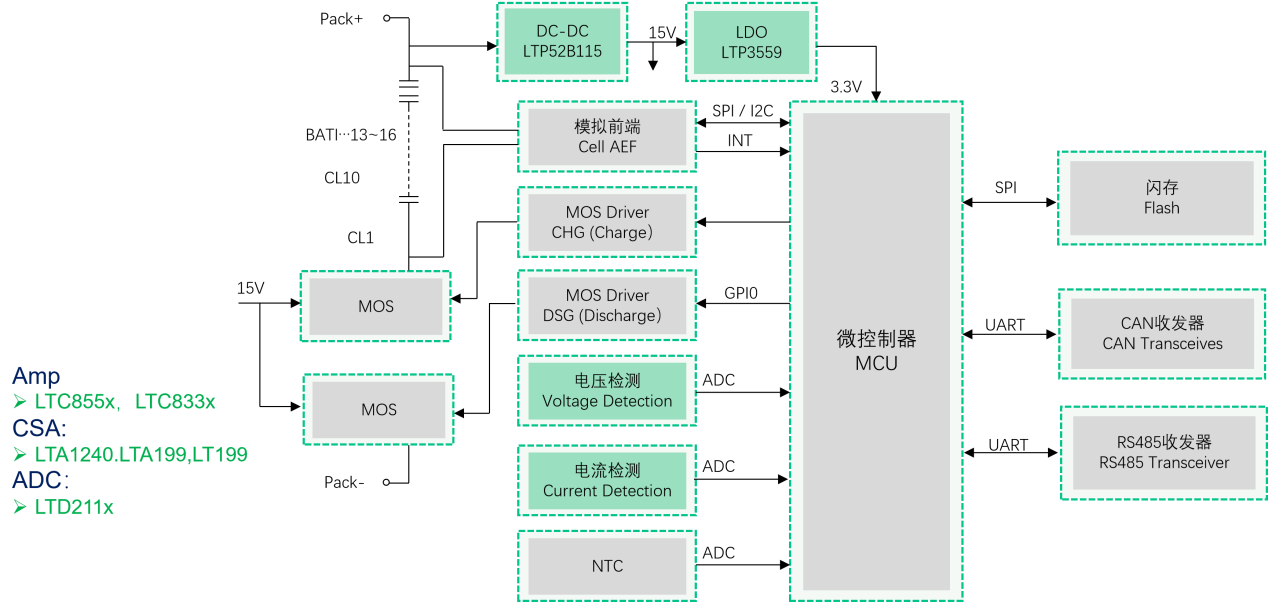
The solution is built around an MCU as the central control unit, integrating key functional modules such as an analog front end (Cell AFE), voltage and current sensing, temperature monitoring, MOSFET drivers, and communication interfaces to establish a comprehensive robotics BMS architecture.
The power management module uses DC-DC converters and LDOs to regulate voltage and provide stable power to control and peripheral circuits. The battery monitoring module combines analog front ends, ADCs, and current-sense amplifiers to acquire key battery parameters, including voltage, current, and temperature. Meanwhile, the charge/discharge control module uses MOSFET drivers to control the power paths through external MOSFETs.
In addition, Flash memory and CAN/RS485 communication interfaces support operating data storage and communication with external devices, meeting the control and data exchange requirements of robotics battery management systems.
2. Key Component Recommendations: Multiple Chip Families Working Together
To address the requirements of power conversion, analog signal acquisition, current sensing, and signal conditioning within a BMS, Linearin offers a range of chip families covering different functional modules and providing flexible component options for battery management system design.
1) Power Management: Low Quiescent Current for Battery-Powered Applications
Robotics BMS designs require different power supply configurations to meet the operating requirements of individual circuit modules. To address high-voltage input, stable output, and low-power operation, Linearin offers two power management devices, LTP52B115 and LTP3559, for different power supply design scenarios.
LTP52B115 is a high-voltage constant-voltage regulator featuring an integrated 150V MOSFET. It supports a wide input voltage range of 18V to 150V and provides 12V or 15V output, making it suitable for Buck and Buck-Boost topologies.
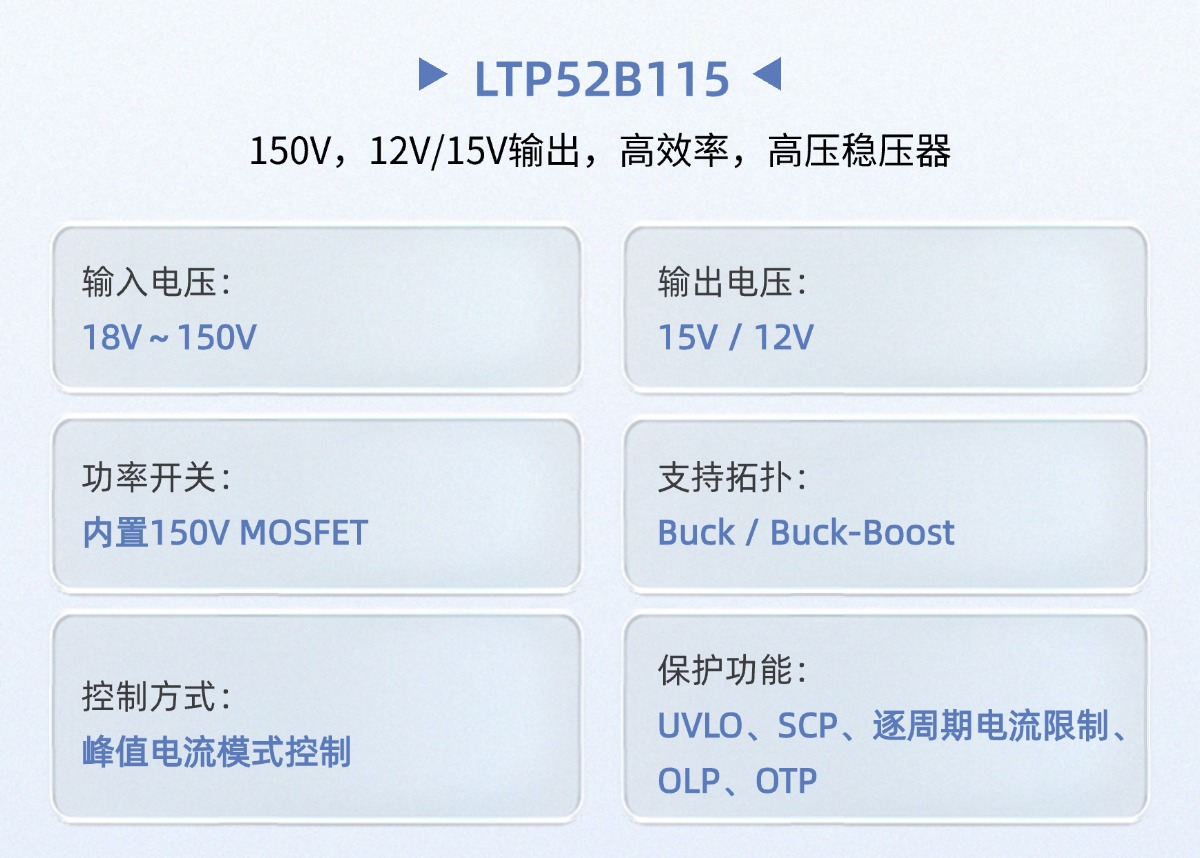
The device employs peak current-mode control and supports a light-load green operating mode to improve power conversion efficiency under varying load conditions. It also integrates undervoltage lockout, short-circuit protection, cycle-by-cycle current limiting, and over-temperature protection, enhancing overall power supply safety and reliability.
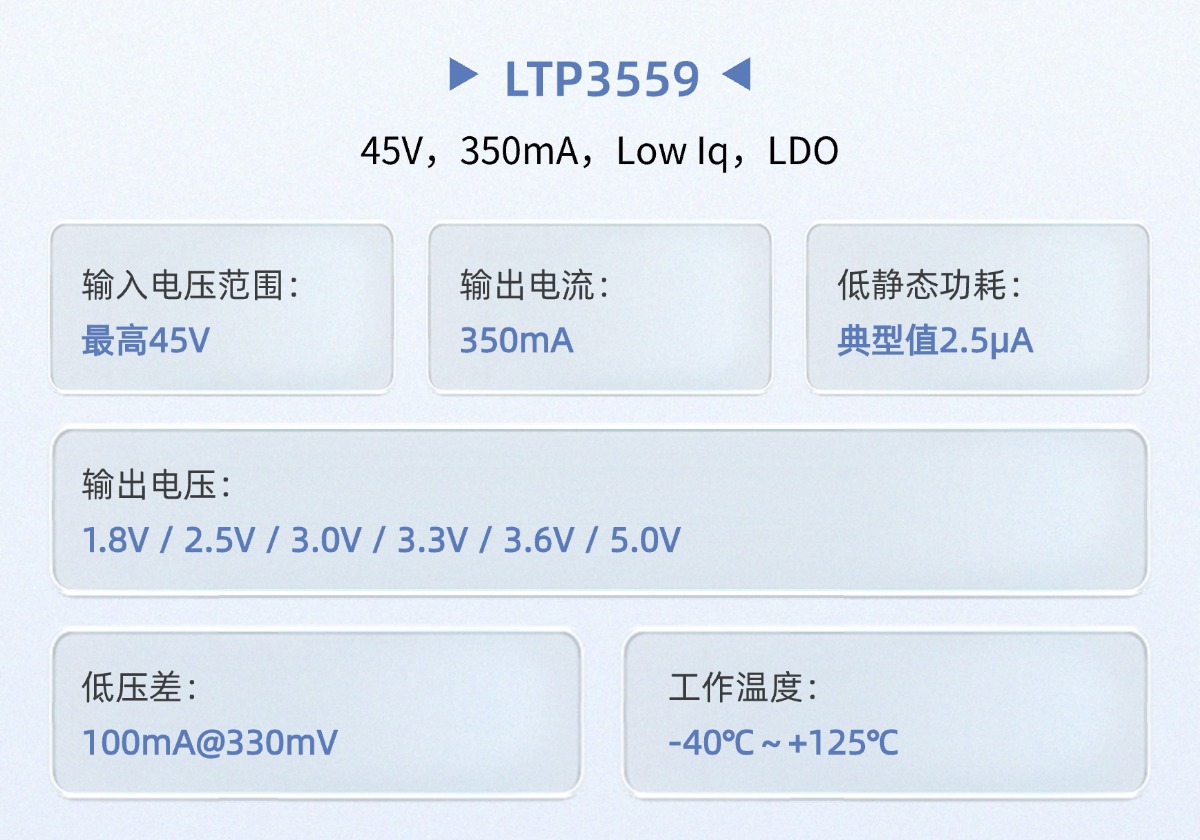
LTP3559 is a low-power LDO designed for power-sensitive applications. It supports input voltages of up to 45V and delivers a maximum output current of 350mA, with a quiescent current as low as 2.5μA.
Featuring a precision voltage reference and feedback control architecture, the device balances output accuracy with low power consumption. Multiple fixed output voltage and package options are available to accommodate different power management design requirements.
2) Current Sensing: Wide Common-Mode Range with Accurate Measurement
Monitoring current variations during battery charging and discharging is essential for evaluating battery operating conditions. To address current sensing requirements across different circuit environments, Linearin offers the LTA1240 and LTA199 series of current-sense amplifiers.
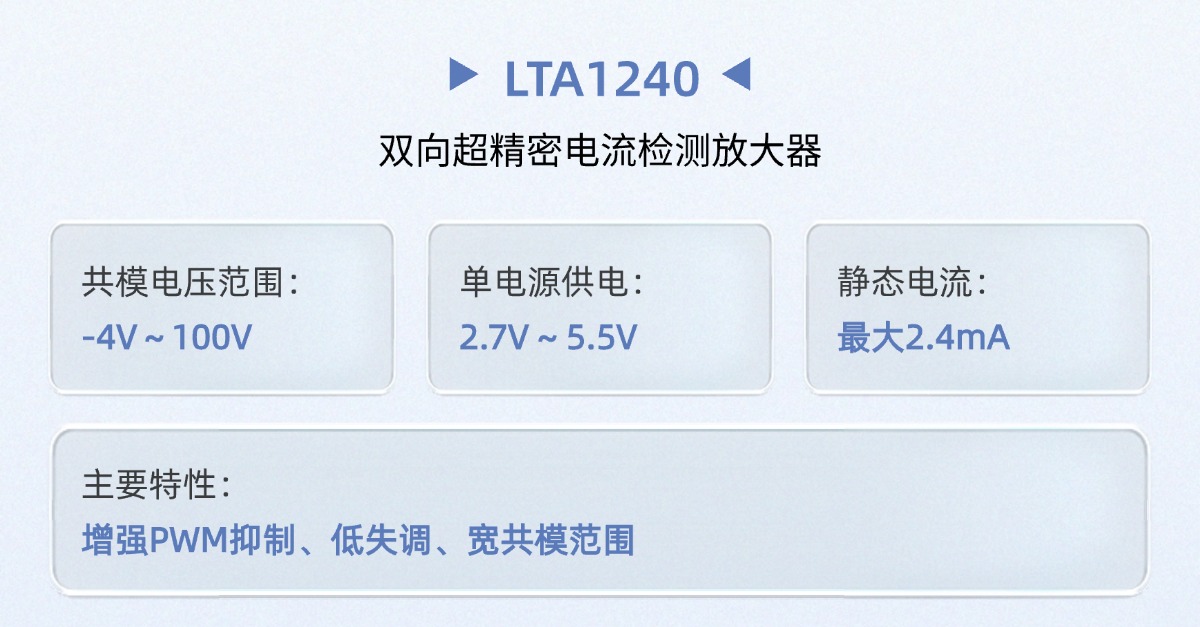
LTA1240 features a zero-drift architecture and enhanced PWM rejection capability, supporting a wide common-mode voltage range from -4V to 100V. It can accurately detect the voltage drop across a shunt resistor in complex switching circuit environments.
Its low offset voltage and high common-mode rejection capability help improve current measurement accuracy.
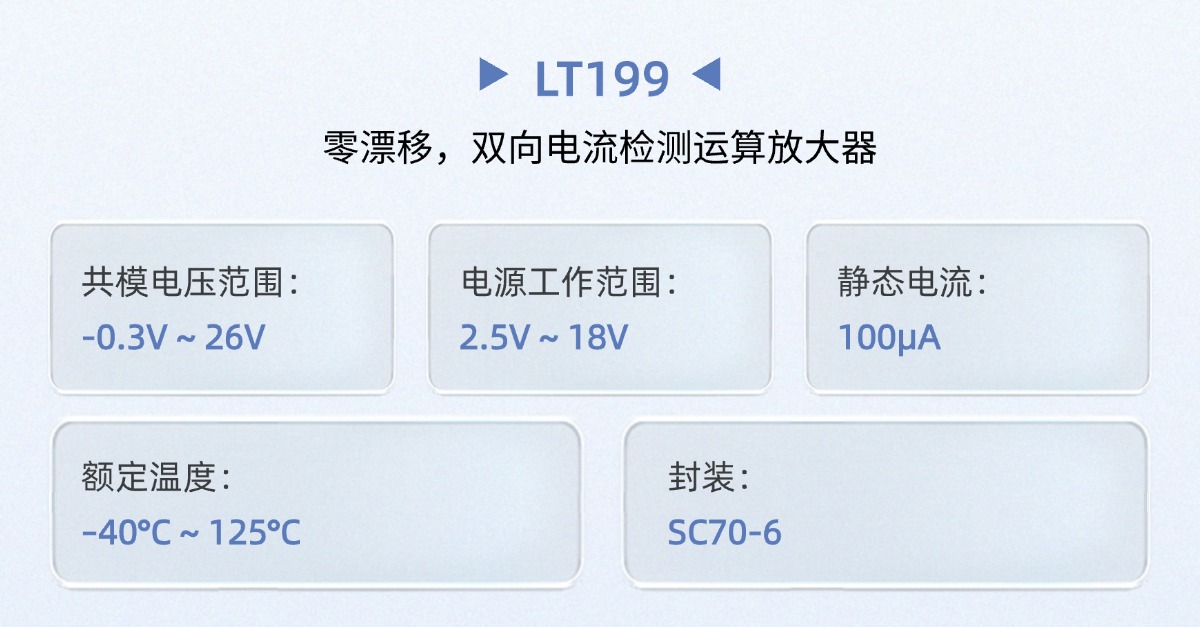
LTA199 Series is a high-resolution current-sense amplifier family featuring integrated, precision-matched thin-film resistors. It accurately monitors current signals on power rails ranging from 0V to 26V and offers excellent input common-mode rejection performance.
Based on a zero-drift architecture, the series features low offset voltage, enabling current sensing with a maximum full-scale voltage drop across the shunt resistor as low as 10mV. Multiple fixed gain options are available to accommodate different current sensing and signal conditioning requirements.
3) Battery Signal Acquisition: 16-Bit ADCs for High-Precision Measurement
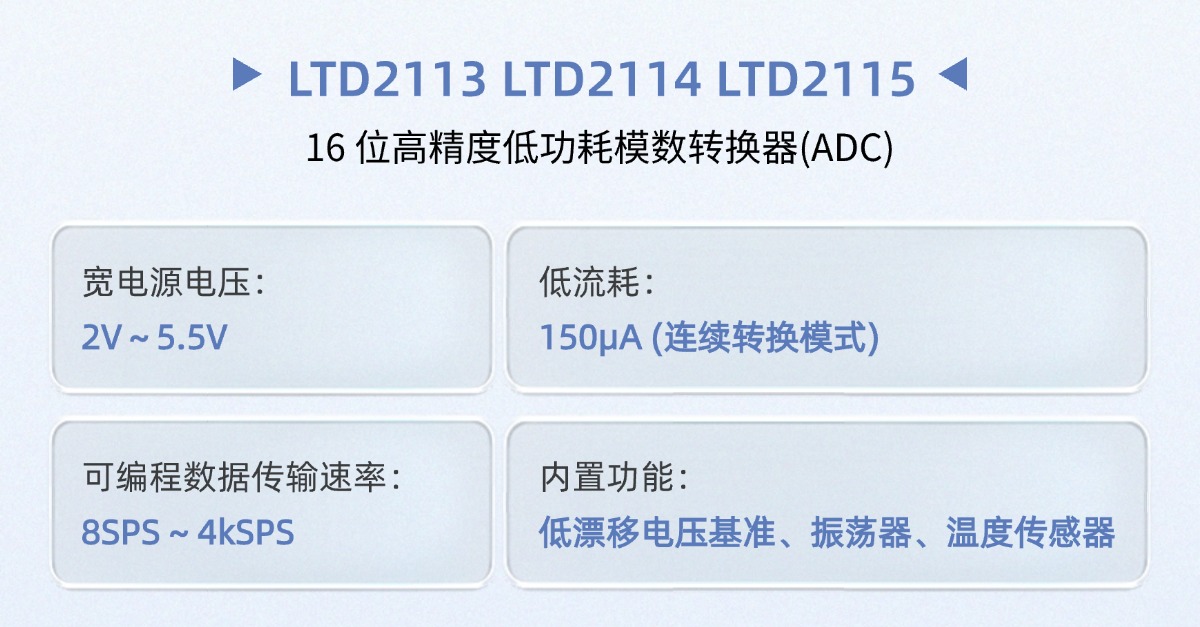
Accurate acquisition of analog signals, including battery voltage and temperature, provides an essential foundation for BMS monitoring and control. To meet these signal conversion requirements, Linearin offers the LTD211x series of high-precision, low-power 16-bit ADCs.
The series integrates a low-drift voltage reference, an internal oscillator, and a temperature sensor. The LTD2114 and LTD2115 additionally feature a programmable gain amplifier (PGA) and digital comparator, while the LTD2115 further integrates an input multiplexer (MUX), supporting two differential inputs or four single-ended inputs.
With different functional configurations across the series, designers can select suitable devices for a variety of analog signal acquisition requirements, supporting battery condition monitoring and system-level temperature measurement.
4) Signal Conditioning: Zero-Drift and Low-Power Operational Amplifiers
In BMS analog signal processing, the amplification and conditioning of low-level signals also play an important role in overall measurement accuracy. To accommodate different bandwidth and power consumption requirements, Linearin offers two families of zero-drift operational amplifiers: the LTC855x and LTC833x series.
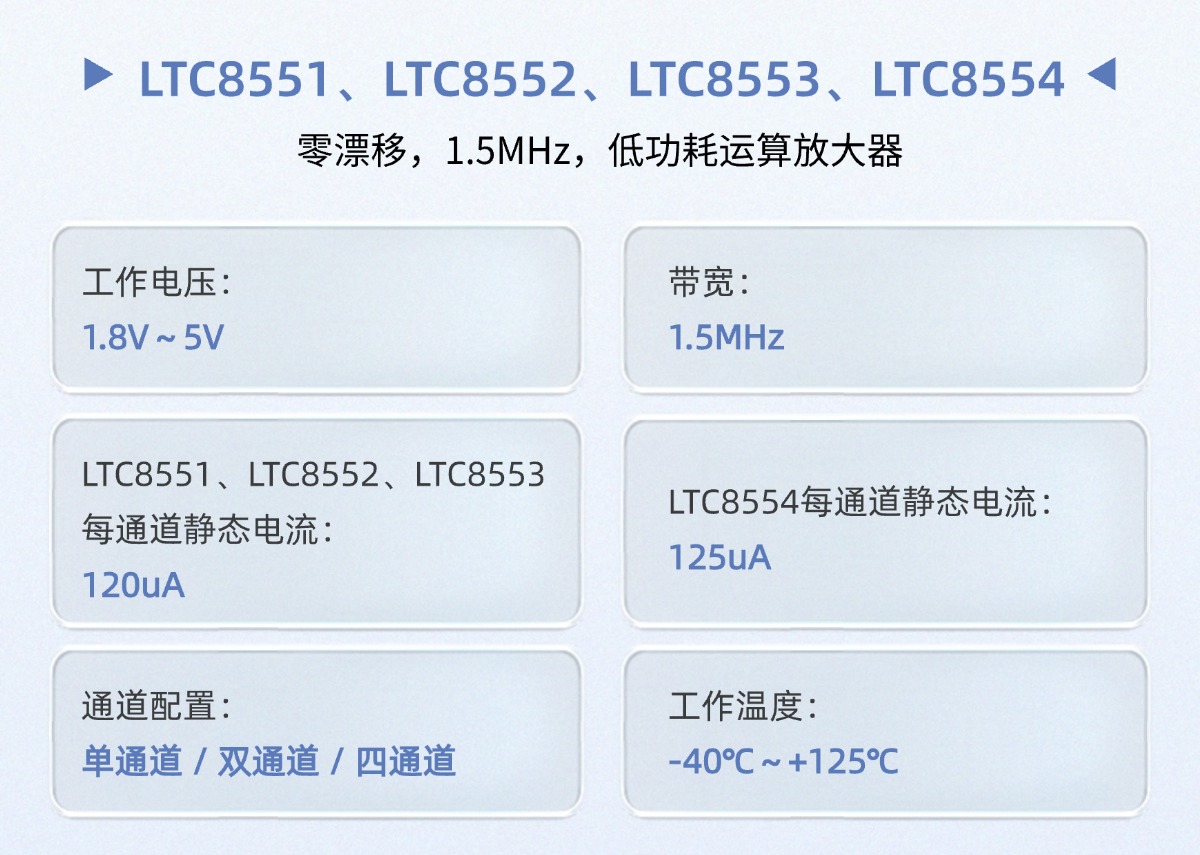
LTC855x Series includes the LTC8551, LTC8552, LTC8553, and LTC8554, offering single-, dual-, and quad-channel configurations. With low offset voltage, low temperature drift, and rail-to-rail input and output capabilities, the series provides bandwidths of up to 1.5MHz, making it suitable for analog circuits requiring both high signal accuracy and fast response.
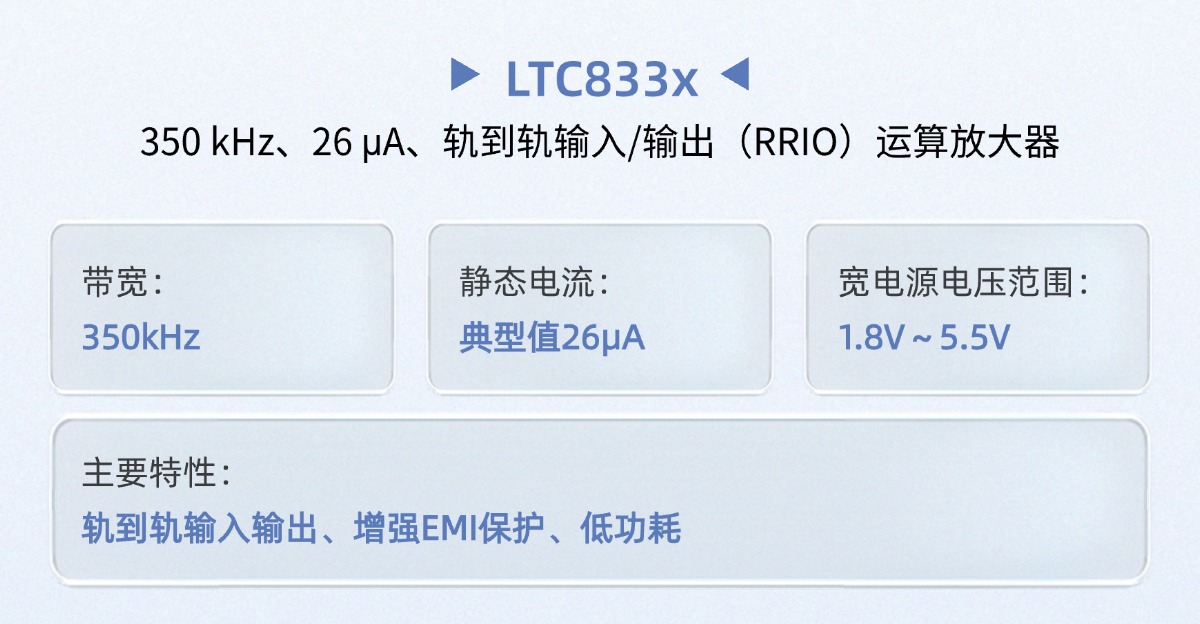
LTC833x Series adopts chopper-stabilization technology to minimize input offset voltage and temperature drift while suppressing low-frequency noise. With a bandwidth of 350kHz and a quiescent current of just 26μA per channel, the series also features rail-to-rail input and output capabilities and enhanced EMI protection, making it suitable for battery-powered and other power-sensitive applications.
3. Solution Advantages: Balancing Precision, Power Efficiency, and Design Flexibility
Robotics BMS applications impose multiple requirements on battery monitoring accuracy, analog signal processing, and overall system reliability. By integrating multiple chip families, Linearin provides targeted component options for key functional modules.
Precision Measurement: 16-bit ADCs, low-drift current-sense amplifiers, and operational amplifiers support accurate acquisition and processing of battery voltage and current signals.
Low-Power Design: Low-quiescent-current LDOs and micro-power operational amplifiers help reduce system power consumption, making them suitable for battery-powered applications.
Flexible Component Selection: A range of common-mode voltage ranges, gain options, and bandwidth configurations allows designers to select devices according to specific circuit requirements.
Comprehensive Functional Coverage: Multiple product families address key BMS analog circuit requirements, spanning power management, signal acquisition, current sensing, and signal conditioning.
From power management and precision sensing to signal conditioning and system control, Linearin's robotics BMS solution integrates multiple chip families to provide a broad range of component options and design support for battery management systems.
As robotics applications continue to expand, BMS designs will face increasingly demanding requirements for measurement accuracy, power efficiency, and operational reliability. Linearin will continue to develop its product portfolio in response to evolving end-application needs, delivering more targeted chip solutions for robotics and other intelligent devices.


Stay up to date with the latest in industry offers by subscribing us. Our newsletter is your key to receiving expert tips.